JMU has risen from upstart Division III program to college football's biggest stage across five decades.
By: Kevin Warner ('02), Associate AD
At his introductory press conference on Dec. 17, 2018, Curt Cignetti was asked why leave a playoff-caliber FCS school to head to a conference rival still at the FCS level. His response?
"There's only one JMU."
Cignetti saw what we, the members of JMU Nation have known for five decades. You can accomplish the unimaginable at James Madison. Each step of the way, the Dukes have checked boxes no one thought possible at "tiny" JMU.
A national title at a school that was rarely a I-AA national threat.
The only school to win a I-AA/FCS national title entirely on the road.
The only non-power school to host three College GameDays.
The first school to break the North Dakota State machine and win in the FargoDome (and only one to do so until Dec. 6, 2025).
The first school since transition rules changed in 1999 to play a full FBS schedule in year one.
The most FBS wins for a first-year reclassifying program.
The most FBS wins for a second-year reclassifying program.
A 40-10 record in four years at the FBS level.
College Football Playoffs 2025.
Excuse JMU alums and fans across decades associated with the school if they are pinching themselves this week. It was a steady, methodical rise from humble beginnings, but each step of the way there were dreams of what could be accomplished.
"There's only one JMU."
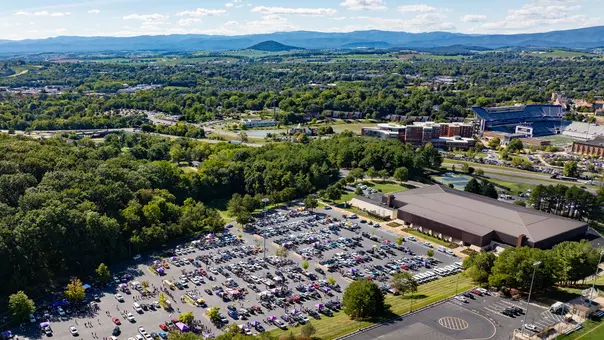
Around 55 years ago, JMU envisioned men's sports as a key strategy to transition a women's institution to co-ed. Class registration lines were used to recruit members of a first football team, and the first games were played on a paint-lined grass field with fans in folding chairs. But there was a vision of how athletics could redefine an institution.
JMU's first football game in 1972 featured fans gathered around Godwin Field.
A program evolved from Division III to I-AA and opponents like Hampden-Sydney and Randolph-Macon were swapped for Yankee Conference traditional powers like UConn, UMass, William & Mary, Richmond and Delaware. As the league evolved to the Atlantic 10 Conference and then the Colonial Athletic Association, JMU occasionally appeared in top 25 polls and made sporadic postseason appearances but was not a consistent dominator.
Yet, the growth continued. Players like Charles Haley, Gary Clark and Scott Norwood proved that good talent could originate from "little James Madison," as the late John Madden used to quip.
Charles Haley was a force from JMU to his NFL Hall of Fame career.
I stepped foot on campus as a freshman in 1998. I recall my high school visit in 1997 for the season opener as unranked JMU faced a ranked East Tennessee State team. As we toured, folks around campus kept telling my family, "Not sure how the football team will do, but the band is great!" Those were the days that folks planned their game day timeline around Marching Royal Dukes performances and 50 yard line seats were abundantly available. Tailgating was modest. There was always school spirit, but folks understood JMU's place at the time in the college sports landscape.
After my freshman year, a guy named Mickey Matthews entered the picture as a new head coach. In his first season in 1999, JMU shocked the Atlantic 10 with a surprise league title with a senior-dominated team. Behind the scenes, leaders like Dr. Linwood Rose, Charlie King and Jeff Bourne aligned on a vision of how athletics could reshape a growing, regional university.
The build was slow. Matthews had to fix roster composition issues. In the 2003 home finale, fans chanted for his exit. But the administration stuck with his rebuild. JMU finished 6-6 and has not had a losing season since, a run of 23 seasons at .500 or better, a streak matched only by Boise State in all of FBS and FCS.
Patience paid off. JMU emerged on the scene in 2004 as a national champion, an improbable run that saw the Dukes win three straight true road games before upending I-AA power Montana in Chattanooga. Few dreamed that JMU football could be a national champion, even as fans did their part to lift spirit, introducing the tradition of purple and gold streamers that season. Yet as fans jumped the high wall at Finley Stadium, clumps of turf clinging to their shoes, the bar had been raised.
Fans celebrated with quarterback Matt LeZotte as JMU was a surprise I-AA national champ in 2004.
Sometimes timing is providential. The title aligned with the opening of a dedicated football support building. And plans fast-tracked to expand Bridgeforth Stadium from 15,000 to 25,000.
JMU remained near the top of I-AA/FCS through 2008 but was upset as the top seed that year against Montana in the first home semifinal game. The Dukes started to fall back slightly in the national discussion. JMU delivered a ripple wave win in 2010, becoming the second FCS school to topple a ranked FBS team with a 21-16 win at Virginia Tech. But success outside of that win wavered. In 2013, the school made the difficult decision to replace a Hall of Fame coach.
Drew Dudzik scored the game winner as JMU defeated Virginia Tech 21-16 in 2010.
In stepped Everett Withers to bring some juice to JMU football, along with an electric former ACC starting quarterback in Vad Lee. The signs were there in 2014 and 2015 that JMU could start an historic rise in the college football landscape.
Lee and the Dukes made noise early in the season, including an electric win at SMU, and attracted a rare FCS visit by ESPN's College GameDay. The college football world learned more about a hidden gem in Virginia's Shenandoah Valley.
Withers left for Texas State and Mike Houston took the helm in 2016. He brought a hard-nosed toughness to the Dukes with memorable locker room speeches. A new mentality built as JMU won a CAA title and earned a high seed for the postseason. The reward was a semifinal trip to North Dakota State, where no one had ever won in the postseason against the five-time defending national champions. But Bryan Schor and the Dukes did the unthinkable and followed with the school's second national title. A new era of JMU football was here, and the Dukes haven't looked back.
John Miller hauled in the game winner as JMU stunned North Dakota State in the FargoDome in 2016.
JMU was solidified as a national power. NDSU media member Mike McFeely penned a memorable headline that a "Sleeping Giant" had been awakened with the Dukes' 2016 season. Murmurs spread among fans questioning if JMU should move up a level to FBS, but the school was steadfast that it would not move unless the opportunity was set up for sustained success.
Houston's Dukes reeled off 28 straight victories, falling in a return visit to the national championship in 2017 in a season that included a second College GameDay visit in three years. After 2018, Houston left for ECU and enter Curt Cignetti, a football lifer who saw a rare opportunity for something special, even turning down Group of Five FBS offers to be the JMU coach.
Cignetti's Dukes were consistent FCS semifinalists and top-five ranked. Even through CoVID and the cancellation of a Fall season, JMU's status didn't waiver.
In the summer of 2021, the SEC's invitation of Texas and Oklahoma sent a tidal wave through college football and conference realignment kicked into high gear. JMU's patience to wait for the right opportunity paid off with an invite to the geographically aligned Sun Belt Conference. JMU reunited with many former peers that made the move to FBS before the Dukes.
Folks wondered how would JMU do leveling up? Typically, schools play a hybrid schedule of FCS and FBS opponents in the first year of reclassification. Instead, JMU immediately played 10 FBS opponents, the most of any school since the transition rules changed in 1999, and beat seven of them to finish 8-3. The program started 5-0 and in year one found itself nationally ranked by the Associated Press.
The following year, JMU started 10-0 to climb as high as 18th by the AP and drew its third College GameDay visit as fans and media alike clamored for college football to "Let us bowl." The rules didn't account for a team that would transition unlike any team in college football history, so a New Year's Six Bowl was not to be. Instead, the Dukes relied on an exception that allowed them to backdoor into a first bowl appearance in the Armed Forces Bowl.
ESPN's College GameDay made its third visit to Harrisonburg with a record crowd in 2023.
To their credit, Indiana recognized something unique in Curt Cignetti, and Bob Chesney entered the picture for JMU's first fully reclassified season in 2024. A new AD also entered the mix in Matt Roan following Bourne's retirement and the university also faced presidential transition with interim leader Charlie King.
So much change, but the winning continued. With a completely depleted roster, Chesney reloaded and led JMU to a 9-4 season and its first bowl win in the Boca Raton Bowl.
Now under the leadership of President James Schmidt, JMU entered 2025 predicted to win the Sun Belt and with some discussion of national impact. With a quarterback coming off a significant nine-month injury, the Dukes hung tough with Louisville but couldn't finish the victory. Perhaps JMU's chance at a "special" season would have to wait another year.
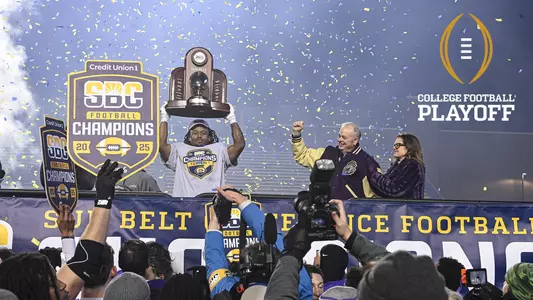
But it was only up from there. JMU reeled off 11 straight victories to earn national rankings for the third time in four FBS seasons and captured its first Sun Belt Championship. It still took a little bit of good fortune for everything to align, and the college football landscape delivered the "chaos" outcome.
James Madison University finished as one of the top five conference champions, higher than the ACC. Hello, College Football Playoff.
Many alums and longtime supporters could never imagine it. But JMU is a place that always achieves above its means and dreams big.
Even as the program anticipates another coaching leadership change, all signs point to raising the trajectory and profile even further under new coach Billy Napier. JMU is 40-10 in four seasons at the FBS level, an unprecedented debut at the sport's highest level.
Maybe no one should be surprised. After all, this is the school that:
Claimed three straight NCAA March Madness first-round wins in 1981 through 1983, before the term "Cinderella" became commonplace. Michael Jordan almost didn't make it to his NCAA title.
Crashed the baseball College World Series in 1983.
Became the first women's basketball program to topple the NCAA Tournament's top seed, No. 1 Penn State, in 1991.
Knocked off traditional powers to win a field hockey title in 1994.
Broke through a sport dominated by the Big Ten and ACC to capture a 2018 lacrosse national title.
Finished in the semifinals of the Women's College World Series in 2021.
Success is not new at James Madison. A school and community that never saw perceived barriers as limitations to what could be possible. Now college football knows that, too.
Enjoy the ride Dukes fans.
"There's only one JMU."
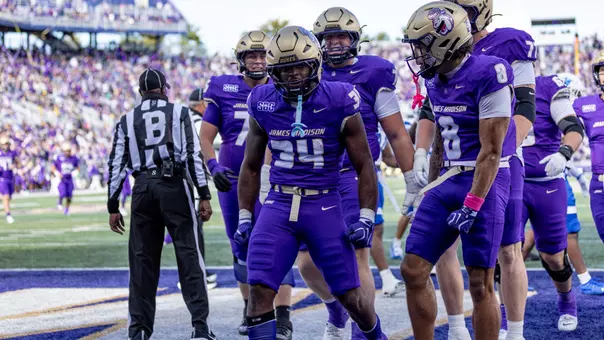
JMU players celebrate during the 2025 Selection Show for the College Football Playoff.