Senior finance majors
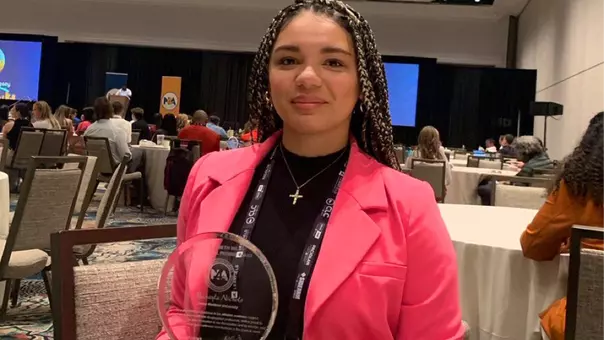
Erica Royal of field hockey and Morgan Cox of golf were selected to attend the Athlete Leadership Connection (ALC), hosted by the Women's Sports Foundation (WSF) at the Morgan Stanley Headquarters in New York on October 15, 2019. Afterwards, they reflected on their experience.
How was your overall experience at the conference?
Cox: We attended the Women's Sports Foundation athlete leadership connection event, and it was a day-long workshop with a lot of interactive events. You worked on developing leadership skills on the course or on the field and translating that into the workforce, because, through athletics, you gain a lot of skills that are transferable to your job. Being able to cultivate those is what can make you a really effective worker. It was a great experience.
Royal: The foundation was started by Billie Jean King to champion the cause of promoting women's sports and specifically women's sports that are underrepresented in comparison to what their male counterparts are getting in compensation, publicity and things like that. There were about 20 to 30 student-athletes from all across the nation. And then there were about 30 to 50 professional athletes. We all came together and did some workshops, and we did a live ESPN podcast taping with Billie Jean King and Julie Foudy. There was a mental health portion with the NCAA Chief Medical Officer, which was really awesome because it focused on how in college athletics can we better support female athletes and specifically within mental health. So it was an awesome, awesome experience and I learned a lot.
 Where were some of your key takeaways?
Royal: The first workshop of the day, we did the Extreme You workshop. It was essentially a self-reflective workshop where you analyze "what are my goals, how can I achieve these goals?" Something that we talked about a lot is the transition from being a student-athlete to a non-student-athlete. The same for professional athletes, when their career comes to an end, what do they do? For a lot of women's sports, there's not opportunity to play after they retire. But what I thought was very interesting was female athletes are having to start off entry level for the first time at age 30. They're gunning for the same jobs I'm going to work, which really put things in perspective for me.
Cox: My takeaway was that if you can actually apply yourself to your fullest potential, you can do a lot more than what you realize. Life seems really busy and it is especially as a student-athlete, but once you organize and really optimize your time you can do more and more and just keep building on what you've learned.
What was the most impactful session?
Cox: I'd say it was a tie between listening to Billie Jean King do the live podcast just because she is such an icon and really a crusader for women's sports. It was just so impactful to hear from her and hear her journey, but also the Extreme You workshop was great, because a lot of times athletes are put into silos of maybe the jock in high school or you fit into some stereotypical category, but when you can actively remove yourself from that and say, "Okay, what, I can be good at a lot of things and can really help develop myself fully." That was something that was eye opening to me.
Royal: I would definitely say the podcast taping with Billie Jean King. They started from when she first picked up a tennis racket. When she was age 11, she told her parents she was going to be the best tennis player ever. At age 13, that's when the Little Rock Nine was happening, and she then decided that she wanted to fight for equality, including race, gender, sexuality, all of that. In 1967 at Wimbledon, she won the singles, the doubles and the mixed doubles, and she was only given 45 pounds, which is insane. She had a lot of wisdom to impart and the fact that she's still having an impact on women's sports today.
 There was a session related to why women are worth watching. In your own words, why are women worth watching?
Cox: Because sports are sports and you should enjoy it not based on whether someone is male or female, but you should enjoy great athletes. I know that women have so many great, great athletes and so many of them are my role models. The way that I view it is that I have male and female athlete role models and both inspire me. I think that's just how you should view it as something that you just need to appreciate sport as it is.
Royal: Because we're miraculous individuals. People say we don't run as hard or we don't jump as high, and I beg to differ because I think that with anything, you have to look at why things are the way they are. They're the way they are for a reason. I think that you have to look at how are people raised, what was the construct to make somebody believe that women weren't worth watching? That's the question that needs to be to be asked. Because we are and we do just as cool stuff as the guys. Just give us our shot!
Mental health is a topic garnering much attention in athletics. What were your takeaways from the mental health session?
Royal: I think that JMU does an awesome job with our support system, especially within athletics. We do an awesome job of providing services and a strong support system for athletes. But I will say, just the overall knowledge that a person can be healthy on the outside and seem healthy overall but on the inside might be a mess. Something I think JMU does well, aside from our formal mental health support system, is having the community that we have. My team might ask me "Hey, Erica, your energy's a little off, what's up?" At JMU that's what we embody. Having that is such a blessing because it's not like that at every school.
Cox: It's incredibly important. It's hard to even quantify how important it is because sometimes you don't even realize that either you or your teammates have the problem. A big takeaway is being aware, both self-aware and aware of your teammates, because you never know when someone needs help. And you never know when that someone is yourself. The more that you can learn the signs and start to take a step back, either through meditation or self-reflection, and say, "Okay, things aren't going great. I need to go get help because I can't just do everything on my own." I think that's a big thing. People think that athletes are stereotyped into being tough, and there's a difference between being mentally tough and being mentally healthy. You can be very resilient but also know that there are times that you need others to help you
 What networking opportunities came from the conference?
Cox: I got to meet some really great industry leaders in finance, and one who actually connected with the JMU students in particular, she is at Morgan Stanley, a managing director in charge of over 1500 financial advisors. She was an equestrian and she and her husband are involved with golf, which is really cool to connect on that. But we met with a mix of the two because you meet with people who may be in a completely different industry, but the traits to success are pretty universal across areas. If you can learn from someone who's been in your shoes and applied themselves to the fullest and done some incredible things, that's where I can learn equally as much as talking to anyone.
Royal: I'm a finance major and I am planning to go into the financial services industry. I'm a little bit further along in my job process, so I wasn't necessarily trying to find somebody to help me find my next position. But it was more just building the network. A lot of the people there were in sports, so it was really cool. I think one of the coolest people I met was Collette Smith. She is the first African-American female to coach in the NFL for the New York Jets. That was really cool because I didn't even know that existed. I met an Olympic water polo player, a professional mountain biker – so it allowed me to learn about different industries and also different sports. I met people who are creating spaces for themselves to be seen, which I think is awesome.
How has the Dukes Lead program within JMU Athletics helped you to grow?
Royal: It has made me more aware of the resources available, not only at JMU but in Harrisonburg. We have workshops on resumes or your first interview or how to leverage your skills as a student-athlete to make them transferable work skills, because we don't have as much time to get real-life work experience. How can you build your student-athlete brand around what you want to achieve? I think that's helped me to package myself and present myself in a way that a person that's not a student-athlete can't. That's invaluable because there are a lot of student-athletes who don't know how to leverage their brand or leverage their time here.
Cox: Dukes Lead really helps you prepare not only for your senior year whenever you're preparing for the workforce, but it carries beyond that. You really have the opportunity to develop the transitioning skills. Many times you don't recognize that you are more prepared than you think you are. You think, "Oh, I didn't have the opportunity to do three internships because I was playing during the summer." But then you realize, "Okay, I actually developed interpersonal skills, teamwork skills, collaboration, resilience, determination, grit, all of these things that really are what you could have learned during an internship." So you actually are more prepared than you think. And when you can cultivate those skills in the right way, you can hopefully really impress an employer.
 Any final thoughts?
Cox: I'm so thankful to JMU for this opportunity to have a school that supports its athletes in a way that Erica and I could attend this event. It's overwhelming. And whenever I was up there, all I could say was how thankful I am to be at this school because Dukes Lead, the mental health awareness that we have here, the support that this school gives its athletes is something that is pretty unique in my eyes. I just cannot thank JMU enough for letting me be a student-athlete here.
Royal: Billie Jean gave us three things that she imparted to us. First, relationships are everything. Second, keep learning and listening and learning how to learn. Third, be a problem solver. I'm so appreciative of this experience. I definitely wouldn't have had the opportunity to be in that room, or be knowledgeable of that foundation, if JMU hadn't given me the opportunity. So for that, I'm so appreciative. I hope that somebody else gets the opportunity to do this and continue learning, because this is an organization that is doing great things in women's sports.
(Images courtesy Molly Choma, Sarah Stier/Getty Images, Morgan Cox and Erica Royal)